
The latest Displays and Industrial PC news from Review Display Systems
Tuesday, 6 October 2020

Friday, 27 March 2020
It’s not all about dumb output devices!
It’s not all about
dumb output devices!
The
importance of appearance…
First impressions last. A customer’s first look at a product often
forms an opinion that stays with them for a long time. We’ve all
done it; wandered into our local electrical retailer, glanced at the
TVs on display and made a decision based solely on how a particular
set has been set up (or even positioned). It’s the ‘we’re
not buying that ‘cos it’s rubbish’ syndrome. As an
industrial manufacturer its vital that the first impression of your
product is a good one. The aesthetic of the case plays a big part, as
does the piece of glass on the front. Industrial manufacturers
traditionally place high regard (not unreasonably) in the display on
the front of their product. However, achieving best results
invariably lies behind the glass.
It’s
not (always) the number of pixels; its how you drive them…
When
specifying an LCD for a product most people are drawn to a panel’s
resolution, it’s brightness and its refresh speed. This, as you’d
expect is a good place to start, however it’s not the whole story
when it comes to getting the best out of your product. BOE (the
Chinese based, largest LCD manufacturer in the world) produce
hundreds of thousands of sheets of glass every week. Identically
sized and spec’d glass go to most of the universally known TV
manufacturers the world over, however the difference in their
finished products can be startling.
Put
bluntly, its all down to how you drive your panel. You can have the
finest 65”, 4k, 1600 cd screen on the planet, but if you feed it
slow, low bit rate information, from a basic specification board,
through an unsuitable driver card down a low bandwidth cable, the end
results will be dramatically underwhelming… it’s all about
partnering the right panel with the right hardware and, potentially
most important of all; matching the hardware to your source
software...
While
we will cover potential system OS in more detail further on in this
article, its worth pointing out that different graphics engines
handle images differently. Anyone who has used an NVidia 1080 pc
gaming card to process HD still images, or used a Quadra graphics
card to play high intensity games will know all about this: both
cards are superb at their chosen field, just don’t try and mix and
match – the end results invariably lead to disappointment…
Additionally,
be mindful of how you compile your code; most graphics engines like
compiled code in a certain format, draw your digital shapes
in the wrong format and again, the results just won’t look right.
Bespoke
versus off the shelf…
In
creating the engine for your system, you will always face a
number of questions; how much physical space do I have? How many
interfaces will I need? How much compute performance will be needed
to get the job done? How much memory and storage are required? What
budget do I have to get this done? How much time do I have to
complete the system? All of these conundrums have been faced by
countless engineers over many decades.
In
years gone by, when businesses employed large design and development
teams, the accepted approach was to set a group of engineers lose on
a project… their tasks were to find a processor, design and lay out
a board, develop code, work out the relevant memory requirements &
finally get prototypes manufactured. Then, more often than not, you
put your creation on test, sat back, hoped, prayed, swore a lot, and
then found yourself re-laying out the board, added more memory,
edited the code stack changed some connectors, re-built a couple of
interfaces and sending the whole thing back to be prototyped again…
if this sounds painfully familiar, I assure you; you were not alone!
Now,
in the days of shrinking design and development departments, and the
depleted all important time to market constraint, the increased
pressure of delivering your own new from the ground up has
never greater.
Of
course, I realise that there is a place for bespoke hardware and
software design. Smaller systems where absolute size (both physical &
code) is paramount, where absolute compute power is less of a
consideration and where mass production volumes will allow
significant economies of scale, will always endear themselves to
bespoke systems. But you may be surprised at how cost efficient an
off the shelf system can be…
Cost,
in its self is a funny thing… such it can be measured in so many
different ways. The price of an off the shelf industrial mainboard is
of course only one part of a long and complex equation. In buying an
off the shelf main board, you invariably obtain any number of things:
External interfaces & ports that provide instant plug and play
functionality, processors that have all the bus routings worked out,
memory interfaces that allow simple upgrade paths. Driving an LCD
(and driving it well!) can become as simple as plugging in an DVI or
HDMI cable. Even the simple act of powering an Industrial mainboard;
simply providing it a 19v DC supply rail, pails into insignificance
against either designing a power supply then creating multiple power
rails to allow your bespoke system to work, or paying for 3 or 4
isolated DC/DC converters and hoping that your board layout doesn’t
spring any nasty surprises on you! It’s worth noting that
Industrial mainboards sold in the UK also come CE marked; giving a
great platform to start getting your end product approved and
certified. All of these ‘bonuses’ in buying an off the shelf
mainboard have a dramatic impact on the alternative cost; that of the
time, effort and stress(!) that an engineering team have to go
through to create their bespoke system.
Speed,
power and performance…
Of
the many benefits in designing with an industrial mainboard, is its
hard to overlook the compute power of an x86 based processor. Yes, I
appreciate the (very valid) arguments that an ARM based system will
be more code efficient, and the purchase price per bit will be
cheaper, but the simple fact remains; a low end Intel J5005 Pentium,
with 8 gig of DDR4 will deliver truly astonishing real world
performance in a multitude of multi-tasking operations. Moving up to
a multi-core i3 or i5 processor with a Q370 chipset, will deliver
performance that was unthinkable only a few years ago, and at a total
system cost that will surprise. Combining an Intel processor with
industrial mainboard from say Aaeon or Kontron allows you to harness
all of the power and flexibility of the CPU in a truly reliable,
fully integrated and scalable solution that provides you with a
solution to tackle the most demanding tasks.
A
proven track record…
Software
has always been something of a conundrum. The unique delight
in finding an undocumented additional feature in the operating
system of your product has the ability to send shivers down the
sternest of spines… Undoubtedly, taking a fully supported off the
shelf software OS removes a deal of the stress from the whole
procedure. However, off the shelf OS packages often contains useful
and helpful additional software that you really don’t want
or need. What would be ideal in this scenario is an off the shelf OS
that has support for 10 years yet is fully customisable and contains
all the drivers, codecs & language packs that you could ever
need. Well, whisper it quietly, but Windows 10 IoT Enterprise gives
you all of the above…
Microsoft,
in enabling Windows 10 IoT Enterprise LTSC 2019 to be elegantly
customisable have given Embedded manufacturers and developers the
flexibility to create a custom OS (which can look as much, or as
little like a Windows OS as you prefer), while retaining the
interoperability of the Windows operating system. Add in the option
of scheduling any Windows updates to coincide with system downtime
and the small but vital addition of the remarkably effective Windows
Defender and you end up with a very practical alternative to
developing your own software stack. You even get a reduced footprint
& a reduction in processor overhead due to the absence of Windows
store, Cortana and the games pack!
Conclusions…
Setting
forth to develop your businesses next range of product can be a
daunting and emotional experience; but it needn’t be quite so
daunting as you first thought… By making use of certified
platforms, with accredited software, your design cycle can be
shortened dramatically. By taking an x86 based industrial mainboard,
which you know delivers the performance and interfaces you require,
allows you to focus on the parts that make your product unique. By
utilising a hugely capable off the shelf OS to cut development time,
allows you to spend more effort on delivering the something
that makes your product vital to your customers.
By
utilising what’s already been developed, adding in your own special
ingredients to make it unique and getting a respected, highly
experienced partner involved from the outset, your future product is
closer than you think. Give us a call; it could fundamentally change
your outlook on system building for life!
Olly
Wainwright
Embedded
Systems Business Development Manager
Review
Display Systems
The
Crown, London Road, Westerham, Kent
+44 (0) 1959 563 345
Thursday, 3 November 2016
AAEON Introduces the new UP² development board
UP² (Squared) is currently the world’s fastest x86 maker board based on Intel Apollo Lake platform and the successor of 2015 Kickstarter supported UP board.
So far, the original UP board has already been delivered to over 12,000 makers, just like you! UP has been used in projects in IOT, Gaming & entertainment, Industrial Automation, Digital Signage, Home automation and more.
This time, we have some amazing ideas for which we need your help. Features, performance and possibilities are about to get squared.
Are you UP for UP² (Squared)?

Check out the full specifications here.
http://www.up-board.org/upsquared/specifications-up2/
Wednesday, 28 September 2016
High bright panels for outdoor advertising.

Advertising out in the elements used to be a case of putting up lots of posters or paying to have your message put on a giant billboard. Now, LCD displays are common everywhere, these offer a number of advantages over the cheaper paper based posters.
With more and more advertisers, it becomes harder and hard to attract customer attention. Key elements of an LCD outdoor advertising display is that it can play video and be updated remotely. These LCD panels if positioned correctly and with suitable content can become entertainment centers can lock in customers in a similar way to television.
So what do you need for this to work? Well firstly it has to be big enough and bright enough to grab the eye. This largely depends on where the unit will be located and how far away the public will be. 32 inch ok if the public is only a few feet away but typically larger screens are needed. Typically RDS uses 32 inch for room systems and 47 to 75 inches for bus stop and shop front systems. To ensure clarity 1000 cd/m2 is needed but we do supply 1500, 2500 and even 5000cd/m2 units. Most of the units RDS supplies come with mounting metal work for customers to install in there own housings but we do also supply completed units that are free standing and battery operated and some units can be mounted on vehicles for a more mobile experience.
How is content displayed? There are number of media players that can be attached to any size screen. The players can be off the shelf or complete custom solutions. They can be loaded with content remotely so once set up, systems can be managed centrally.
Vandalism can be an issue, screens can be mounted with thick vandal proof front panels strong enough to resist impacts but still enable touch for an interactive experience. There are also a number of industrial keyboards and mouse systems that can be used to enable full customer interaction with systems if required. All the systems can be made waterproofed to IP67 specifications or above as required.
Using TFT for out-door advertising is a proven cost effective technology. Advanced in technology allow user interaction as well as static displays. If you have any projects you would like to discuss please get in touch.
Daniel Burke
01959 563 345
www.review-displays.co.uk
Tuesday, 23 August 2016
Rugged Tablet computers and why can't use an ordinary Apple of Samsung Tablet.
So you need a way to capture data in the field, you need a mobile device running Windows or Android for data capture and monitoring. Many people faced with this requirement immediately look at consumer grade standard tablet Computers. Standard Tablet Computer (STC) such as a Samsung tablet, look great, are easy to obtain and are cheap. Buy a few of these; give them to your staff with a bit of software on them and away you go – job done. It is very tempting to do this but as I will explain it is a false economy and you will open yourself up to a load of problems you didn’t think about.
A decent 10.1 inch Tablet costs around £300, is lightweight, easy to get and are easy to setup your own Windows or Android apps. A Rugged Tablet computer (RTC) costs £700-£1000, is a lot thicker and heavier and can only be sourced from a few suppliers. Why choose an RTC over an STC?
A Case Study
A shipping firm in Africa needed a way for staff to walk around the dock and monitor containers. The staff needed to check cargo numbers as they were unloaded. They decided to use locally sourced consumer grade tablets. These were bought and loaded with the docks application and given to staff. Job done! It worked for a while until two of the tablets went “missing” after a week. These were replaced (took a week), shortly afterward one developed a fault on its charging port because the staff were not careful when plugging in the chargers, another was dropped and broke the screen. These units were sent off for repair under warranty leaving only three working devices. It took five weeks to get the units repaired.
During operation several staff complained the screens weren’t bright enough, being Africa it was very bright outside and their tablets were difficult to read in direct sunlight. Several of the devices shut down when they got hot, staff managed to work round this by trying to keep the devices in the shade. Several of the devices developed faults in operation which was traced down to staff installing games on the devices which interfered with normal operation. Staff wanted to scan the bar-codes on some of the containers and so separate scanners were needed, the tablet they had did not have a full sized USB port so two new different units were bought with full USB sockets. This meant staff had to carry two devices around and more tablets were broken due to staff dropping the units. Cases were bought for the devices to try to protect against drops. The charging connector on the tablets was a constant source of problems and more tablets had to be bought since the repair turn-around could be months. This meant always having spares units doing nothing in case of failure. The batteries did not last all day, some busy days the units ran out of power and so had to be left in the office to recharge, this meant buying more units and leaving some on charge.
The advantages of buying consumer grade products is mainly price, but in the example above the initial price is only one aspect of the overall Cost Of Ownership (COO). If you add up all the costs involved in this example you can see that the initial purchase price of the units is only a small part of the true costs. Five units were needed, customer bought two extra with full USB ports and 3 extra to allow for repairs and battery issues. Meaning in effect the customer had to buy 10 units to ensure 5 were operational at all times. Any additional features that were required meant buying new tablets.
Additional costs are:Shipping back and forth for repairs.
Additional purchases for new features and spares.
Additional units to allow for battery longevity issues.
Lost productivity due to units out of action.
Additional protection.
Anti theft costs.
IT costs for fixing software issues caused by staff tampering.
Reductions in productivity due to tablet limitations such as temperature and screen brightness issues.
Buying new units to get new features.
Additional purchases for new features and spares.
Additional units to allow for battery longevity issues.
Lost productivity due to units out of action.
Additional protection.
Anti theft costs.
IT costs for fixing software issues caused by staff tampering.
Reductions in productivity due to tablet limitations such as temperature and screen brightness issues.
Buying new units to get new features.
It’s difficult to add up all these costs but it is easy to see that the £300 retail price is easily doubled if not trebled to get the real cost of ownership.

RTC-700A
The customer bought 5 of the 7 inch RTC-700A units from AAEON which cost approximately £700-£800 each. These units are designed for industrial use, have higher range of temperature operations and hot-swap batteries. Additional docks and bar-code scanners can be bought later IF and when required without changing the original units. The 700A is much less likely to be dropped or stolen (does not have access to the Google apps store by default), is protected in case of drops, has full size USB ports, hot swap batteries as well as a range of add-ons. This unit has already saved the customer countless hours of productivity, reduced installation and operational costs and generally saved time and money on repairs and maintenance.
 RTC-600A
The AAEON RTC units come in 5.7 inch, 7 inch, 10.1 and 11.9 inch units. The larger units can run Windows as well as Android and have a range of options such as WI-FI, 3G, Bar-code readers, docking stations with extra ports.
If you would like to know more about our range of rugged computer equipment please contact RDS on 01959 563 345. WWW.REVIEW-DISPLAYS.CO.UK


Thursday, 18 August 2016
Kaby Lake Intel Core processor: 7th-gen CPU news, rumors and release date

Intel showed off a glimpse of what its latest chips are capable of during its IDF 2016 keynote, but not much else so far. Read on to learn more about that very glimpse.
Kaby Lake is the next generation of CPUs from Intel. Right now we're in the Skylake generation. You'll still see quite a few laptops from the previous Broadwell and Haswell series on sale, but they are officially past-it.
Here are all the details you need to know on the upcoming Intel Kaby Lake CPU revolution.
Cut to the chase
- What is it? Intel's 7th-generation Core processor
- When is it out? Before the end of 2016
- What will it cost? Likely similar to Intel's current Skylake processors
Intel Kaby Lake release date
Kaby Lake is on our doorstep. Intel CEO Brian Krzanich confirmed on July 22 that Kaby Lake chipsets have made their way to PC builders.
This means we can expect to see a few Kaby Lake PCs arrive before the end of 2016. However, right now we don't know the exact chipsets that will arrive in the first wave.
Kaby Lake includes desktop CPUs, Intel Core i3/i5/i7 laptop CPUs and new Core M chipsets, as well as server-class models.
Even after Intel's keynote at its very own 2016 Intel Developer Forum in San Francisco, Calif., we do not yet know the release date of the 7th generation of Intel Core series processors. However, at the show, Intel showed off a Dell XPS machine running a 7th generation Core i5 chip running recent shooter darling Overwatch using its own onboard GPU. We expect to learn more details shortly.

Kaby Lake leaked CPUs
Three Kaby Lake CPU models have already been leaked, though, one from each of the three mainstream lines of Intel chipsets. The Core i7-7700K is the leaked desktop CPU.
This tells us the Kaby Lake naming convention will remain similar: they are "7" series CPUs, to Skylake's gen 6, Broadwell's gen 5 and so on.
The i7-7700K is a quad-core hyper-threaded CPU, and benchmarks leaked all the way back in March suggest it's clocked at 3.6GHz with a 4.2GHz turbo boost. Of course, that may change by the time the chipset is actually used.
The CPU was leaked in the SiSoft benchmark result database, but unfortunately the results published are actually significantly worse than those of the i7-6700K, so don't tell us anything about Kaby Lake's performance. A downgrade upgrade? Let's hope not.
Next up is the Core i7-7500U, leaked alongside the i7-7700K. This is the sort of CPU we might end up seeing in a high-end ultrabook. It's a relatively high performance chipset, but still belongs to the "U" ultra-low voltage family.

It has two cores, four threads, and is clocked at 2.7GHz with a 2.9GHz turbo. Some of you might turn your noses up at dual-core laptop chipsets, but they're pretty important.
The most on-trend leaked CPU of the lot, though, is the Intel Core M7-7Y75. This is likely to be used in some of those impossibly slim laptops whose frames are filled more with battery than anything else.
Intel Kaby Lake first laptops
Where will these chipsets end up? None of the key laptops makers have officially announced any Kaby Lake laptops yet. They couldn't without having access to the hardware, not to mention letting Intel announce the chipsets first.
Apple Insider suggests that Apple is not among the first manufacturers to get hold of the new chipsets. Of course, Apple is more at risk of alienating buyers by offering early-as-possible upgrades, when its MacBook lines were only refreshed in April 2016.
It doesn't need to be in as much of a rush as, say, Asus or Lenovo.
Some suggest Apple may skip over Kaby Lake altogether, but this seems unlikely when its successor Intel Cannonlake is not due to arrive until the second half of 2017.
Intel Kaby Lake architecture
Cannonlake is likely to prove a much more exciting update than Kaby Lake too. You see, Kaby Lake is very similar to the Skylake family we're already using. This is not what we originally expected of the Skylake successor, but Intel has changed how its processor development works.
Since 2007, Intel has worked in a 'tick, tock' rhythm of upgrades, where one generation shrinks the die, followed by a generation that alters the architecture. That changed this year. As of 2016, Intel now uses a "Process, Architecture, Optimisation" approach, and Kaby Lake represents that last, frankly least interesting stage.
It's still a 14nm processor, it's fairly similar to Skylake throughout and the desktop variants will use the same LGA 1151 socket. Unless something terrible goes wrong, Cannonlake will shrink Intel CPUs down to the long-promised 10nm die in 2017.
While there are likely to be some performance and efficiency improvements, it seems unlikely those with a Skylake CPU will need/want to upgrade to a Kaby Lake processor of the same level.

Intel Kaby Lake upgrades
There are some distinct improvements involved in Kaby Lake, though. The first is fully integrated support for USB-C Gen 2. Skylake machines can offer this already, but need an extra third-party piece of hardware. It'll soon be 'native'. Again, it's not exciting but is necessary.
Gen 2 USB 3.1 enables bandwidth of 10Gbps, rather than 5Gbps. Thunderbolt 3 support is in too.
In a similar vein, HDCP 2.2 support is native in Kaby Lake. This digital copy protection, a newer version designed for certain 4K video standards. Ultra HD Blu-ray is the key one.
Kaby Lake is also expected to offer integrated GPUs better-suited to 4K video, although no exact details are available on the tech. This may simply mean more power. After all, current Intel Core-series CPUs can already output to multiple 4K monitors using integrated graphics. They just won't be to happy about the fact if you start doing anything remotely demanding.
Kaby Lake will only officially support Windows 10 too, among Windows operating systems. This is yet another attempt by Microsoft to push those lingering on Windows 7, or anything a little newer, into the present.
Apollo Lake: Kaby Lake's poor cousin
It's also worth considering the low-end Atom chipsets you'll see used in very cheap laptops and Windows 10 tablets in (potentially) late 2016 and 2017. These are not part of Kaby Lake, but a separate family called Apollo Lake.
No Apollo Lake-powered laptops have appeared yet, but early reports suggest a performance increase of as much as 30 per cent. This is good news given how poorly some Windows 10 devices currently run using low-end hardware.
Kaby Lake-X: a higher-end future
If you're only interested in mainstream Kaby Lake models, the future isn't looking too complicated. They'll trickle out, before being replaced by Cannonlake CPUs in late 2017. However, the outlook for seriously high-end hardware is more convoluted.
Right now Intel's newest high-end CPUs are part of the Broadwell-E series, even though among mainstream processors Broadwell is already old news. Quite simply, the real high-end hardware comes later. We're talking about CPUs like the £1000 i7-6900k.
The Kaby Lake alternative will not be called Kaby Lake-E but Kaby Lake-X, and is expected to launch in the second half of 2017 alongside Skylake-X. That's right: two generations at the same time.
Kaby Lake-X will reportedly offer a four-core processor, while Skylake-X will man the ascent to the almost-baffling 10-core version.
What mere mortal laptop and desktop buyers need to take from Kaby Lake, though, is that a) we'll see machines using the new chipsets very soon and b) unless you already need an upgrade you might want to see whether 2017's Cannonlake brings more exciting improvements.
Tuesday, 9 August 2016
The PICO - IMX7 - EMMC. A tiny board with big ambitions.

Over the last decade computer systems have become more powerful and smaller with each new generation. Here we are in the early 21st century and this trend continues. Technexion have recently released a new system on a chip (SOC) called the PICO-IMX7-EMMC, it's tiny. This little board measures 36mm by 40mm, the CPU power that this little unit has is just plain amazing.
It's based around the NXP i.IMX7 chipset and has two versions; the 800MHz solo and 1GHz Dual core unit. It utilizes up to 2 GB of DDR3 RAM and has onboard 4GB of eMMC storage. These features alone make it ideal for embedded applications where processing power is needed in a small space but it gets better.
The PICO board has a huge array of IO ports:
Edison I/O @ 1.8V
9 x GPIO
4 x PWM
2 x I2C
1 x I2S
1 x SPI
2 x UART
USB-OTG
SDIO (4-bit)
Additional I/O @ 3.3V
24 bit TTL RGB
RGMII LAN
CAN
USB Host
I2C
Operating systems that run include Linux 3.x, Yocto and Brillo.
The choice for embedded systems now is vast and with boards like the PICO IMX7, more and more power is available in a very small space.
Specifications
| Processor | NXP i.MX7 Solo / Dual |
| Technology | ARM Cortex-A7 single core @800Mhz + Cortex-M4 ARM Cortex-A7 dual core @ 1Ghz + Cortex-M4 |
| Power Management IC | NXP PF3000 |
| System Memory | Upto 2GB LPDDR3 |
| Storage | onboard eMMC (default 4GB) |
| Operation System | Linux, Yocto, Android , Ubuntu |
Connectivity
| Gigabit Network RGMII | Signals routed to board-to-board connector |
| Wireless LAN | Broadcom BCM4339 802.11ac |
| Bluetooth | Broadcom BCM4339 Bluetooth v. 4.0 |
Connectors
| Board-to-Board | 1x Intel Edison compatible connector (Hirose 70-pin) 2x Hirose 70-pin connectors |
I/O Interface Signalling
| Edison I/O @ 1.8V | 9x GPIO 4x PWM 2x I²C 1x I²S 1x SPI 2x UART USB-OTG SDIO (4-bit) |
| Additional I/O @ 3.3V | 24-bit TTL RGB MIPI CSI Camera MIPI DSI Display PCIe RGMII (gigabit LAN) Flex CAN version 2.0B Compliant |
Video
| PXP | Image re-sizing, rotation, overlay and CSC Pixel Processing Pipeline |
Audio
| Interface | I²S (1 channel) |
| Audio Codec | On Carrier Board |
Power Specifications
| Input Power Requirements | 4.2 ~ 5.25 VDC |
Environmental and Mechanical
| Temperature | Commercial : 0° to 60° C Extended : -20° to 70° C Industrial : -35° to 85° C (no WiFi possible) |
| Humidity | 10 - 90% |
| Dimensions | 36 x 40 mm 1⅜ x 1⅝ inch |
| Weight | 8 grams |
| Certification | Compliant with CE, FCC, RoHS, REACh directives |


For more information on the Technexion PICO IMX7 please contact RDS on:
01959 563 345
Wednesday, 27 July 2016
Moore's law is dead.... or is it?
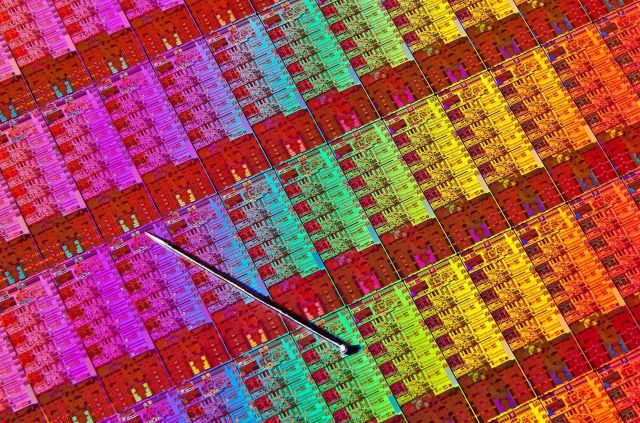
A Haswell processor close up.
If you know anything about processors you will have heard of Gordon Moore. He was the co-founder of Intel and came up with his now famous law.
MOORES LAW : The observation made in 1965 by Gordon Moore, co-founder of Intel, that the number of transistors per square inch on integrated circuits had doubled every year since the integrated circuit was invented. Moore predicted that this trend would continue for the foreseeable future.
This basic observation by Moore has held true since 1965 but things are about to change. Every year newer and better ways to put transistors on silicon are found. The size of each transistor reduces allowing chip designers to cram more and more in the same size. This basic process has reached its limit. According to the International Technology Roadmap for Semiconductors (ITRS) transistor can't shrink any more. Moores law is dead?
The ITRS—which has been produced almost annually by a collaboration of most of the world's major semiconductor companies since 1993—is about as authoritative as it gets when it comes to predicting the future of computing. The 2015 roadmap will however be its last.
The most interesting aspect of the ITRS is that it tries to predict what materials and processes we might be using in the next 15 years. The idea is that, by collaborating on such a roadmap, the companies involved can sink their R&D money into the "right" technologies.
For example, despite all the fuss surrounding graphene and carbon nanotubes a few years back, the 2011 ITRS predicted that it would still be at least 10 to 15 years before they were actually used in memory or logic devices. Germanium and III-V semiconductors, though, were predicted to be only five to 10 years away. Thus, if you were deciding where to invest your R&D money, you might opt for the iii-V rather than nanotubes (which appears to be what Intel and IBM are doing).
The latest and last ITRS focuses on two key areas :
It will no longer be economically viable to shrink transistors after 2021
What might be done to keep Moore's law going despite transistors reaching their minimal limit.
(Remember, Moore's law simply predicts a doubling of transistor density within a given integrated circuit, not the size or performance of those transistors.)
It will no longer be economically viable to shrink transistors after 2021
What might be done to keep Moore's law going despite transistors reaching their minimal limit.
(Remember, Moore's law simply predicts a doubling of transistor density within a given integrated circuit, not the size or performance of those transistors.)
The first problem has been known about for a long while. Basically, starting at around the 65nm node in 2006, the economic gains from moving to smaller transistors have been slowly dribbling away. Previously, moving to a smaller node meant you could cram tons more chips onto a single silicon wafer, at a reasonably small price increase. With recent nodes like 22 or 14nm, though, there are so many additional steps required that it costs a lot more to manufacture a completed wafer—not to mention additional costs for things like package-on-package (PoP) and through-silicon vias (TSV) packaging.
This is the primary reason that the semiconductor industry has been whittled from around 20 leading-edge logic-manufacturing companies in 2000, down to just four today: Intel, TSMC, GlobalFoundries, and Samsung. (IBM recently left the business by selling its fabs to GloFo.)
The second problem, how to keep increasing transistor density has a couple of likely solutions. First, ITRS expects that chip makers and designers will begin to move away from FinFET in 2019, towards gate-all-around transistor designs. Then, a few years later, these transistors will become vertical, with the channel fashioned out of some kind of nanowire. This will allow for a massive increase in transistor density, similar to recent advances in 3D V NAND memory.
The gains won't last for long though, according to ITRS: by 2024 (so, just eight years from now), we will once again run up against a thermal ceiling. Basically, there is a hard limit on how much heat can be dissipated from a given surface area. So, as chips get smaller and/or denser, it eventually becomes impossible to keep the chip cool. The only real solution is to completely rethink chip packaging and cooling. To begin with, we'll probably see microfluidic channels that increase the effective surface area for heat transfer. But after that, as we stack circuits on top of each other, we'll need something even fancier. Some form of electronics blood, perhaps?
The final ITRS report is a bit of a monster and I have only touched on a few aspects of it. There are large sections on heterogeneous integration, and also some important bits on connectivity (semiconductors play a key role in modulating optical and radio signals).
One interesting piece of short term decision making that will happen very soon is choosing which lithography and patterning techs will be used for commercial 7nm and 5nm logic chips. As you may know, extreme ultraviolet (EUV) has been waiting in the wings for years now, never quite reaching full readiness due to its extremely high power usage and some resolution concerns. In the mean time, chip makers have fallen back on increasing levels of multiple patterning—multiple lithographic exposures, which increase manufacturing time (and costs). Now, however, directed self-assembly (DSA)—where the patterns assemble themselves—is also getting very close to readiness. If either technology wants to be used over multiple patterning for 7nm logic, the ITRS says they will need to prove their readiness in the next few months.
So on the face of it Moore's law looked dead but there are a number of new techniques and technologies waiting in the wings that may well allow us to get round the current limitations. Time will tell.
An "EPIC" journey.
An “EPIC” journey beyond the standard.


AAEON goes on an “EPIC” journey beyond the Standard.
EPIC: An Introduction
In 2004, the PC/104 Embedded Consortium released the standard for Embedded Platform for Industrial Computing, more commonly referred to as EPIC. This standard for SBCs was intended to fill the gap that existed between the small, stackable PC/104 solutions and the larger EBX solutions. According to the PC/104 Embedded Consortium, “the purpose of this specification is to define a physical platform for the mid-sized embedded Single Board Computer (SBC) with multiple I/O expansion options. Its size is midway between the industry standard PC/104 stackable format and EBX SBC format. The added space allows for combining features on an SBC which would normally be found on multiple PC/104 modules”

As noted by the PC/104 Consortium, the EPIC standard defines a board that has x and y dimensions well- suited for smaller embedded industrial PC systems. With more board level real estate, EPIC systems can accommodate greater I/O integration as compared to its sister PC/104 standard that would require more stack-on peripheral boards. The dimensional increase also allows for the use of higher performance processor that often call for advanced heat dissipation. Take note of this issue of heat dissipation.
Reduced Total Cost of Ownership AAEON’s EPIC products are fully tested for compatibility and equips a comprehensive set of core functionalities that render additional modules unnecessary (less expansion), effectively lowering the total cost of ownership (TCO) by 10 ~ 20%.
Legacy I/Os Expandability In computing, looking back is as important as looking forward. In that regard, AAEON’s EPIC products are designed to support legacy systems with the inclusion of the PC/104, PCI-104 (or PCIe) for prolonged use of tried-and-true systems while future-proofing it with newer, more modern technologies.
CPU Solder up Design
Since the Cedar View platforms, aka EPIC-CV07, EPIC-BT07, EPIC-QM77, EPIC-BDU7, AAEON’s EPIC products have boosted the “Solder up” design that places the CPU at the solder side of the PCB. Aiming to take the hassle out of thermal management, the design allows users to adopt a broader range of coolers (even making the idea of treating the chassis as a heat sink possible) without altering the layout of the components, saving development and system integration costs.
Since the Cedar View platforms, aka EPIC-CV07, EPIC-BT07, EPIC-QM77, EPIC-BDU7, AAEON’s EPIC products have boosted the “Solder up” design that places the CPU at the solder side of the PCB. Aiming to take the hassle out of thermal management, the design allows users to adopt a broader range of coolers (even making the idea of treating the chassis as a heat sink possible) without altering the layout of the components, saving development and system integration costs.

Wide Voltage Solution
Depending on the situation for which the solution is deployed, voltage can be a major hurdle to overcome. With this idea in mind. AAEON’s EPIC products are built to support a wide voltage range of 9-24V design to reduce the possibility of damaging the onboard components in the event a DC to DC converter module is used. In addition, the extended voltage range grants enhanced adoptability as up to 80% of today’s industrial requirements can be adequately satisfied, without the need for additional power modules. Flexible System Assembly
The EPIC standard is exceptionally well-suited for smaller embedded industrial PC applications with its generous dimensions, offering a compact system with I/Os most conducive in today’s industrial use. AAEON’s EPIC board offers has on them up to six USB ports (USB 2.0/ 3.0), eight COM ports (RS-232/422/485), and two Mini-PCIe slots to satisfy the needs for extra components without assembling additional I/O modules.

“EPIC” Technology in Action The AAEON family of EPIC SBCs offers a line of versatile solutions. These highly integrated SBCs can be found serving the requirements of various industry segments from mobile infotainment to industrial automation, and even in the retail space. Due to the fact that AAEON has made these EPIC SBCs much like a component in terms of mechanical and thermal consideration, the benefits they bring to application developers are truly “EPIC” and considerably minimize the limitations for implementation.

EPIC-SKS7 The EPIC-SKS7 is the latest and most advanced member of AAEON’s EPIC product family with a 6th Generation Intel® Core™ processor. The enhanced performance delivered by the chips came in form of support for up to 16 GB of DDR4 memory and clearer, higher resolution video output, making it viable in demanding applications such as high resolution machine vision equipment or mini-servers. The board also sports a CPU socket allowing for greater flexibility.
EPIC-BDU7
Based on the Broadwell platform, the EPIC-BDU7 carries a U-series CPU that lowers power consumption to 15 W, while still delivering impressive performance for 4K resolution media content or triple independent displays. The abovementioned solder up design is featured on this board in addition to the inclusion of the PCI-104 interface, two features that place the board in an ideal position for applications where legacy systems are in place and convenient thermal management is required, namely industrial automation and certain military equipment.
EPIC-BT07 While the Intel® Core™ series is deemed overpowered for certain applications, such as industrial HMIs, the EPIC-BT07 will be up to the task with its lower grade, but less power hungry Intel® Atom™ CPU. Still sporting a solder up design, the board is capable of dual displays as well as wide voltage support of 9 ~ 24V with a healthy set of I/Os, including six USB ports, two RJ-25 ports, and as many as six COM ports. Similar to its Broadwell counterpart, the EPIC-BT07 also uses a fanless thermal solution.
Based on the Broadwell platform, the EPIC-BDU7 carries a U-series CPU that lowers power consumption to 15 W, while still delivering impressive performance for 4K resolution media content or triple independent displays. The abovementioned solder up design is featured on this board in addition to the inclusion of the PCI-104 interface, two features that place the board in an ideal position for applications where legacy systems are in place and convenient thermal management is required, namely industrial automation and certain military equipment.
EPIC-BT07 While the Intel® Core™ series is deemed overpowered for certain applications, such as industrial HMIs, the EPIC-BT07 will be up to the task with its lower grade, but less power hungry Intel® Atom™ CPU. Still sporting a solder up design, the board is capable of dual displays as well as wide voltage support of 9 ~ 24V with a healthy set of I/Os, including six USB ports, two RJ-25 ports, and as many as six COM ports. Similar to its Broadwell counterpart, the EPIC-BT07 also uses a fanless thermal solution.
EPIC-CV07 & EPIC-QM57 The most mature and seasoned platform among the AAEON EPIC product family, the EPIC-CV07 and EPIC-QM57 have been the staples of the product line and ideally suited in applications ranging from industrial machinery to intelligent transport. Support for legacy systems are highlighted with the boards’ PCI-104 and PCIe interface as well as older operating systems such as Windows XP. In addition, the EPIC-CV07 carries as many as eight COM ports while the EPIC-QM57 sports a CPU socket for greater flexibility.
About AAEON AAEON is a leading manufacturer of advanced industrial and embedded computing platforms. Committed to innovative engineering, AAEON provides integrated solutions, hardware and services for premier OEM/ODMs and system integrators worldwide. Reliable and high quality computing platforms include industrial motherboards and systems, industrial displays, rugged tablets, PC/104 modules, PICMG half-size and full-size boards and COM modules, embedded SBCs, embedded controllers and related accessories.
AAEON also offers customized end-to-end services from initial product conceptualization and product development on through after-sales service programs.
AAEON is a GSA contract holder (#GS-35F-0470Y) serving the Federal, State & Local government sectors. AAEON is also an Associate member of the Intel® Internet of Things Solutions Alliance. From modular components to market-ready systems, Intel and the 400+ global member companies of the Alliance provide scalable, interoperable solutions that accelerate deployment of intelligent devices and end-to-end analytics. Close collaboration with Intel enables Alliance members to innovate with the latest technologies, helping developers deliver state-of-the-art, first-to-market solutions.

More information can be found regarding all of AAEON’s product lines at http://www.review-displays.co.uk or call us on 01959 563 345

Subscribe to:
Posts (Atom)